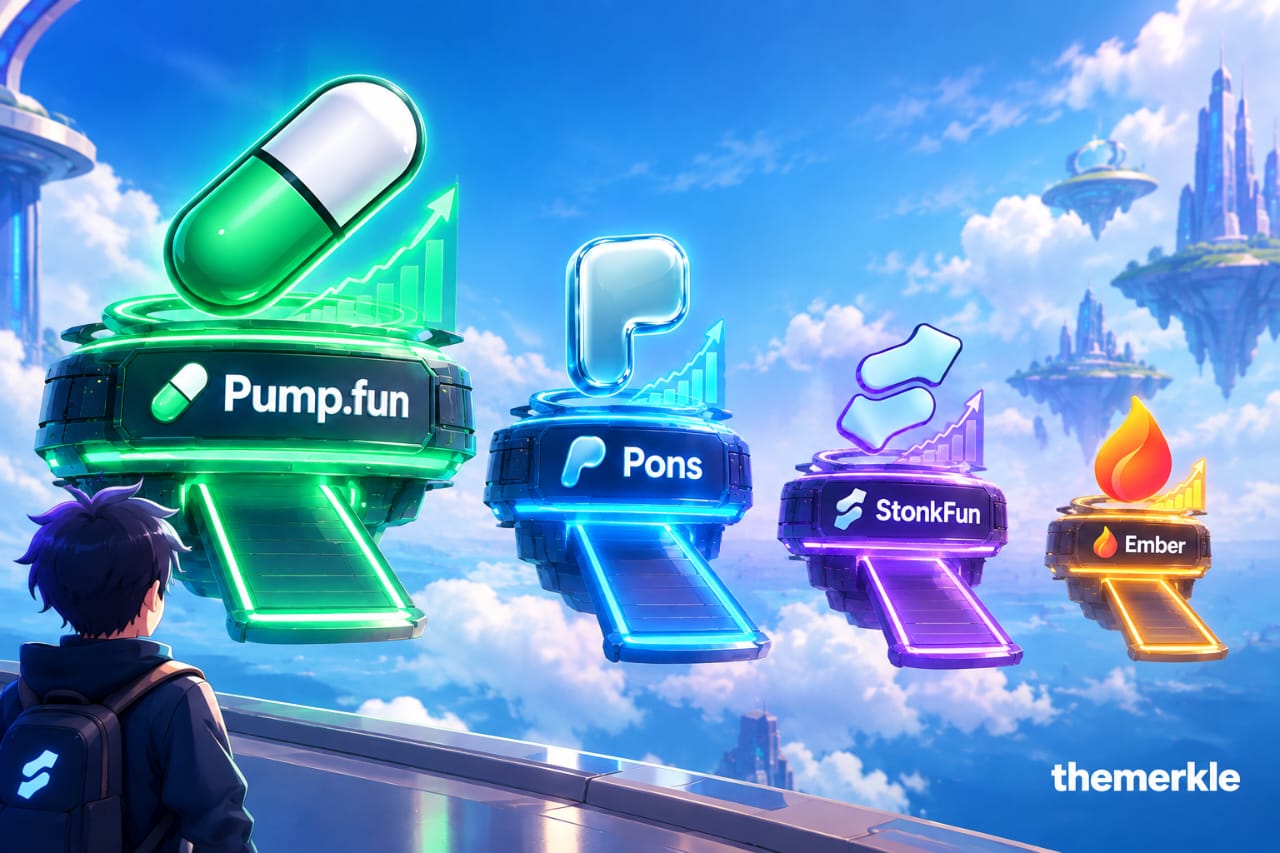
A tweet making the rounds lined up four launchpads by market cap, Pump.fun at $2.9B, Pons at $550M, Stonk.fun at $180M, and Ember at $30M and asked a simple question: which one has the biggest upside from here?
That's a fair way to frame it, but a market cap on its own doesn't tell you why each of these exists or what's actually driving the number. So I went straight to each project's own website, its own token page, and its own live dashboard, and pulled what's there. Here's what each one is, where it came from, and where it stands as of today, September 14, 2026.
1. Pump.fun ($PUMP)
Where it came from. Pump.fun launched on Solana on January 19, 2024. The idea was simple: anyone could create a token in under a minute, no code needed, no liquidity to raise upfront, no presale, no team allocation. Coins go straight onto a bonding curve and are tradable the second they're created. That's still exactly how the platform describes itself today on its own homepage:
"the fairest way to launch and trade memecoins on Solana."
How big it got. On its own $PUMP token page, Pump.fun says it became the fastest-growing company in history, hitting $100M, $300M, and $500M in cumulative revenue faster than any company on record. When it later launched its own token, $PUMP, the token sale reportedly sold out in 12 minutes.
Where it stands right now. Straight from Pump.fun's own dashboard:
- Annualized revenue: $463.30M, roughly $1.27M a day on a 90-day average
- $PUMP price: $0.003627, down 3.2% on the day
- Market cap $1.45B, fully diluted valuation $3.63B
- 231.4K holders, 399.46B $PUMP circulating out of a 1T total supply
- Latest published burn (Sep 13, 2026): 145.4M $PUMP bought back and burned in a single day, worth $446.0K, about 37.78% of that day's revenue
The mechanism behind the burns is public: since April 28, 2026, half of daily protocol revenue is locked in and automatically used to buy $PUMP on the open market, then burn it. Two burn addresses are published on the page so anyone can check the numbers themselves.
Why people watch it. Pump.fun is the platform that made this whole category exist. It's also, by a wide margin, the biggest of the four, which means new money has to show up in the billions, not the thousands, to move the price meaningfully from here.
2. Pons ($PONS)
Where it came from. Pons runs on Robinhood Chain, the blockchain Robinhood Markets launched publicly on July 1, 2026. Pons went live within days of that launch and quickly became the busiest place on the chain to create and trade new tokens. Its own protocol page on DefiLlama, which sources its numbers directly from each project's on-chain contracts and disclosed methodology, describes it plainly: "Pons is a token launchpad for creating and trading fixed-supply tokens that progress toward liquidity." In practice: deploy a token along with its liquidity pool in a single transaction, start trading immediately on a bonding curve, and graduate automatically into a locked, permanent liquidity pool once the token reaches its threshold.
How the money moves. Every trade carries a fee. A share goes to whoever created the token, a share goes to the protocol, and a portion of the protocol's cut is used to buy $PONS on the open market and burn it, reducing supply over time.
Where it stands right now, per DefiLlama's live Pons protocol page:
- $PONS price: $0.53
- Market cap: $381.26M, fully diluted valuation $370.05M
- Fees over the last 30 days: $119.24M
- Revenue over the last 30 days: $21.41M
- Holders revenue over the last 30 days: $11.55M, the share of revenue used to buy back and burn $PONS
- DEX volume over the last 30 days: $1.937B
- $PONS volume in the last 24 hours: $74.98M
Why people watch it. Pons is the clearest sign that the exact same launchpad model that worked on Solana can be rebuilt fast on a brand-new chain, especially one with a big, trusted name behind it. It's also the newest of the four, which means less history to judge it by.
3. StonkFun ($STONK)
Where it came from. StonkFun is a Solana launchpad with one clear twist: instead of pairing new tokens against SOL or a stablecoin like most launchpads do, it lets creators pair a token against a tokenized stock, an ETF, a commodity, or another crypto asset. Its own token, $STONK, is paired against a tokenized version of the S&P 500.
How the money moves. StonkFun's own live numbers, published in full with methodology on DefiLlama's StonkFun page, break the fees into three sources: a platform fee on every trade against the bonding curve, a creator fee on trades once a token graduates into a full liquidity pool, and a share of ongoing fees from that locked liquidity. A large chunk of protocol revenue is then used to buy $STONK on the open market and burn it.
Where it stands right now:
- Fees over the last 30 days: $9.93M
- Holders revenue over the last 30 days: $4.92M
- DEX volume over the last 30 days: $164.44M
- $STONK price: $0.23, market cap $191.54M, fully diluted valuation $191.54M
- $STONK volume in the last 24 hours: $57.59M
Why people watch it. StonkFun's whole pitch is that pairing mechanic, it's a genuinely different product, not just another copy of Pump.fun with a new coat of paint. The tradeoff is that pairing a token against a tokenized stock gives price exposure, not any real ownership or shareholder rights in the underlying company.
4. Ember ($EMBER)
Where it came from. Ember is a bonding-curve launchpad built on Solana using Meteora, one of Solana's liquidity infrastructure protocols. Its own homepage describes it directly:
"Meteora bonding-curve launchpad. Pair with 1,200+ Meteora-approved tokens and tokenized stocks; half of every trade's tax goes to holders, burns, a SuperLotto or your team, automatically, on-chain."
How the money moves. Ember's core idea is transparency about where fees actually go. Instead of fees quietly building up in a treasury somewhere, the split is designed to run automatically, on-chain, roughly every 15 minutes, some of it to holders directly, some to burns, some into a lottery-style reward pool, some to the team.
Where it stands right now. Ember is by far the youngest and smallest of the four, sitting around $30M market cap. It publishes a live, running public ledger on its own site tracking total fees collected and total tokens burned since launch, so anyone can watch the mechanism work in real time rather than take it on faith.
Why people watch it. Ember's angle isn't a new pairing model, it's making the "where does the money actually go" question answerable in real time, on-chain, for anyone who wants to check. The tradeoff is simply time: it's the newest of the four, with the shortest track record to judge it against.
My honest takeaway
None of these numbers exist to tell you what to buy, they exist so you can check the story against the real data instead of just the headline market cap. Pump.fun is still the biggest and most proven, which also means it needs the most new money to move meaningfully. Pons has grown fast on a brand-new chain and its 30-day numbers are now the largest of the three smaller platforms by a wide margin, but it's also the youngest and the most reliant on that chain staying hot. StonkFun has a genuinely different product built around pairing tokens with real-world assets. Ember is the smallest and newest, betting on transparency as its edge rather than a new mechanic.
Every number above is public and checkable, the dashboards, burn addresses, and token pages are all linked so you can go verify them yourself before making any decision.
Disclosure: This is not trading or investment advice. Always do your research before buying any cryptocurrency or investing in any services.
Follow us on Twitter @themerklehash to stay updated with the latest Crypto, NFT, AI, Cybersecurity, and Metaverse news!