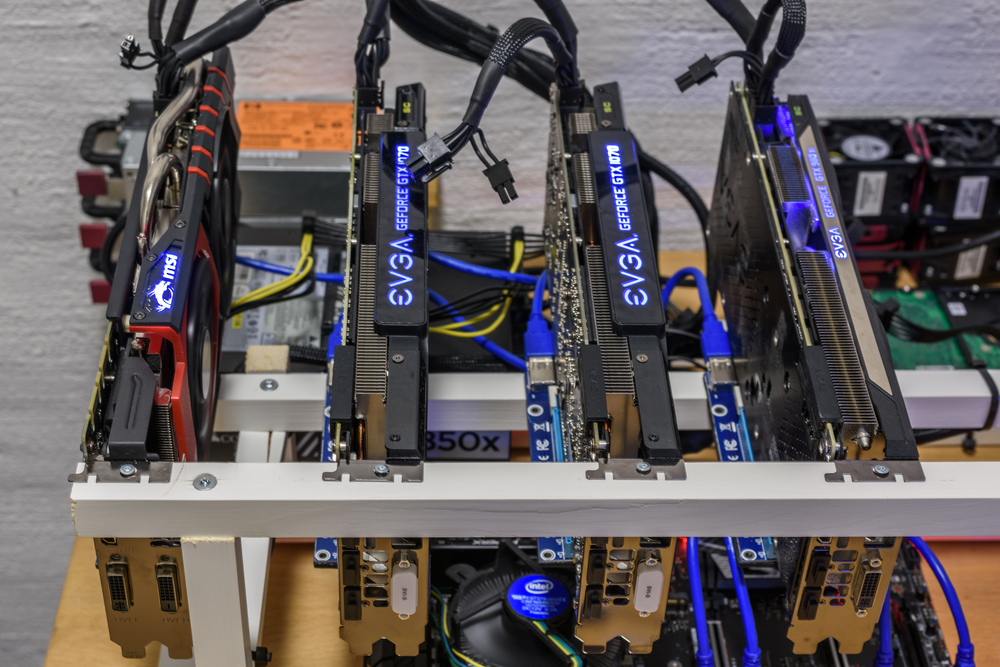
Interest in mining cryptocurrency has skyrocketed lately. This has caused a major wave of sales of PC graphics cards, which has actually driven up the price of many mid-range cards. Mining with a GPU may even turn a profit if one has access to cheap electricity. However, this process is known to damage graphics cards and affect their longevity. People considering mining should keep these factors in mind, particularly if they plan on reselling their cards later on.
Mining Is Tough on GPUs
It makes a lot of sense to mine cryptocurrency with a graphics card. They are easy to come by, are not overly expensive in most cases, and can result in excellent hashpower after making some initial adjustments. In fact, the AMD Vega Frontier edition may soon mine Ethereum at 70MH/second, assuming the rumors are true. Setting up a GPU mining rig requires doing some tweaking, and getting multiple cards to mine using the same motherboard can be tricky at times. Once a rig is up and running, most people simply leave their hardware hashing away. If needed, it will switch mining pools on its own. Most miners will hardly pay attention to the hardware itself, choosing to monitor things from a distance. That does not mean your hardware does not need checking up on, however, as it remains under a lot of stress while mining cryptocurrencies. This level of stress is often underestimated. When you start mining cryptocurrency, your GPUs are constantly under a full load at all times, and their fans typically spin at the highest RPM. That might sound less stressful than spinning up and cooling down again, but that is not necessarily the case. Keeping GPU fans running at a constant speed at all times will serve to wear them out comparatively quickly. Even though fans are designed to spin quite a bit, their longevity is severely affected by the rate at which they are forced to run. However, not using fans while mining cryptocurrency is most definitely a bad idea.Thermal cycling is also something to think about when mining cryptocurrency using GPUs. Although one would expect mining to entail relatively low thermal cycling, that is not the case by any means. That said, some tweaking of each card's power limit setting may make this a trivial issue more often than not. Reapplying thermal paste on a GPU every so often does wonders to keep the card cool and avoid major damage. Note that the process should not have to be repeated too often; it can be done less than once per month.Pushing a graphics card to its full load on a constant basis can always result in card failure. In most cases, the card would have to run at full speed for over a year for this to happen, although your mileage may vary based on the model, maker, and general condition of the card. Electronics are always prone to manufacturing issues, which often only appear after the device has been put through the proverbial wringer. That being said, there are plenty of miners who have seen their cards fail over time and even catch fire as well.
Contrary to games and other computational tasks, cryptocurrency mining runs a GPU at full capacity almost constantly. Even stress tests only keep this up for so long before they risk damaging cards. Cryptocurrency mining of any sort will stress a card to its limit for as long as it is running. Granted, most models can handle that with ease, but it will always impact the card in one way or another. Those effects may not become apparent immediately. One of my own cards worked fine for months after a year of mining altcoins and then started artifacting suddenly. Whether or not the upcoming line of AMD and NVIDIA GPUs dedicated to cryptocurrency mining will suffer from these issues remains to be seen. There has to be a reason why these cards are better suited for the job compared to regular GPUs. So far, very few specifics have been unveiled to the public regarding these GPUs. They will be more efficient, of course, but they may also improve in other ways like handling loads better and degrading slower. As a rule, people who take good care of their GPUs will rarely encounter issues.
The driving demand for better internet and access to information continues to grow. For example, OECD countries saw an increase in the usage of high-fiber by 15% between June 2020 and June 2021. In addition, businesses within the economic cooperation and development alliance rely on their websites to share their products and blogs with their consumers. TRUiC…
A 2020 report by the Organization for Economic Co-operation and Development stated that, “Insurance companies paid out a higher amount in claims in 2019 than in 2018 in most reporting countries.” The increase in claims, as stipulated by the report, has been evidenced to be as a result of the pandemic. Covid-19 caused many businesses to seek financial aid and…
According to researchers, several factors lead to being a successful entrepreneur. The most important is identifying opportunities, being comfortable when facing uncertainty, and making efficient business decisions, even when faced with insufficient information. As you start your new business in 2022, you require resilience, motivation, determination, and fl…
It is reported that between 70-80% of consumers look up businesses online before making a purchase. This showcases the importance of business websites within the digital age, where consumers are as invested in online branding and information, as they are in physical stores. Similarly, more and more businesses are opening solely within the online space within…